Responsible Gambling for Online Pokies in New Zealand 2026
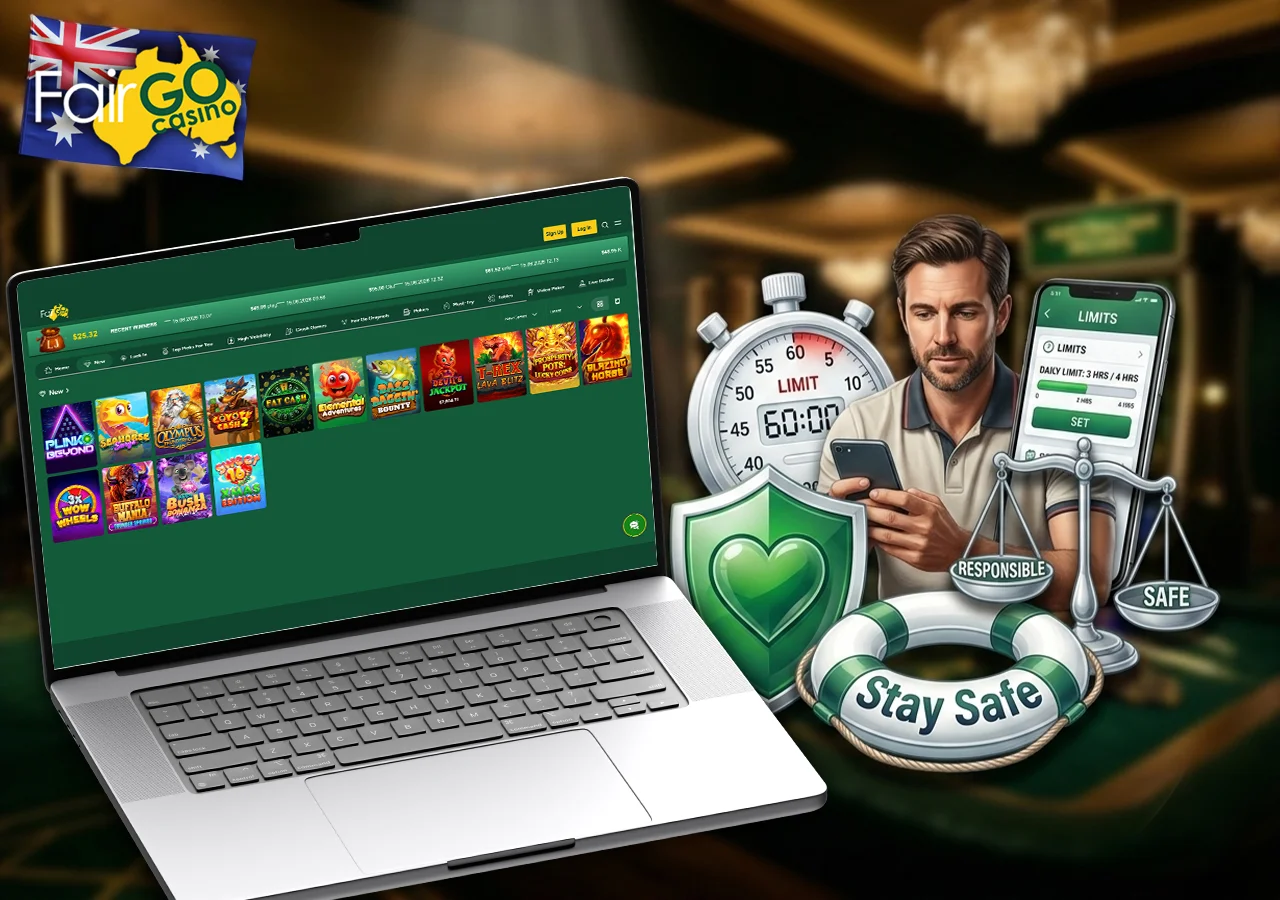
Gambling can become an issue if users don't practice responsible gambling. The New Zealand Gambling Law Guide published a statistic for 2026. It states that around 0.5% to 2% of New Zealand adults are problem gamblers. It's roughly 22,000 to 104,000 people. An additional 1.5% to 2% are categorized as moderate-risk gamblers who experience related harm.
Gambling is now more regulated, for example, the Online Casino Gambling Bill that went live in May 2026, so players have access to responsible gambling tools. However, gamblers have to actively use these tools, set limits, and access New Zealand support services if needed.
IMPORTANT! Offshore online pokies sites reviewed on this page are NOT regulated by New Zealand authorities. The country also doesn't have a national online self-exclusion register. Kiwi players are responsible for setting caps and using limiting tools.
PGF Group recommends gamblers to set reminders to quit gambling after periods like 20-30 minutes.
Our Commitment to Safe Gaming
This website reviews online pokies websites that are available to New Zealand gamblers. The role of this platform is to provide information, such as reviews, comparison of casinos, their services, bonuses, terms, and so on. The website doesn’t provide gambling services nor does it process payments, as the site isn’t a casino operator.
We are committed to promoting responsible gambling practices in general. We recommend players to use the gambling tools available at the reviewed online pokies sites. We mainly review offshore online casinos with licenses from regulators in Malta, Gibraltar, and Curacao.
These are common tools that are accessible at reviewed offshore pokies sites:
- Deposit limits.
- Wagering limits.
- Session time limits.
- Cooling-off periods.
- Account self-exclusion.
IMPORTANT! The content available on this platform is strictly informational. We don’t promote casinos, nor do we encourage excessive play at any website in general.
What is Responsible Gambling?
Responsible gambling is a practice of recreational play with strict personal limits on a budget and play periods. You gamble responsibly when you use disposable income and treat the process as entertainment, not a method to earn money. It’s as important to set limits on deposits and wagers as it is to actually follow personal limitations.
All casinos, in general, have a mathematical edge. It’s called the house edge which is a percentage that the casino keeps as profit.
The house edge and RTP are essentially similar terms. The first explains the casino advantage as a percentage that it keeps, while the second describes the amount a user theoretically receives after long periods.
For example, a game with RTP 96% means that the house edge is 4%. You must understand that even titles with high RTP like 96-97% and more return less than every dollar staked over time.
Therefore, knowing this information, it’s important to accept losses during play as the cost of entertainment. Responsible gambling means you don’t chase those losses, trying to win money back.
You can reinforce healthier habits if you use available responsible gambling tools such as deposit limits, wagering limits, session timers, self-exclusion, etc.
IMPORTANT! Pokies are classified by the New Zealand Ministry of Health as the highest-risk gambling product. Pokies require more self-control because they have fast gameplay that encourages repeated play.
Warning Signs of Problem Gambling
There are several signs that indicate a potential problem:
- Hiding gambling activity from whānau, friends or partners. A person subconsciously understands that there’s an issue and tries to hide the problem from the closest people who can help.
- Chasing losses — increasing wagers to recover what’s been lost. As mentioned, the house always has the advantage, and increasing the wagers’ size or volume only leads to more problems.
- Gambling affects relationships, work, study or family responsibilities. A person starts prioritizing gaming activity over spending time with closest people and completing daily/work tasks.
- Emotional distress related to gambling — anxiety, guilt, irritability. Instead of positive emotions and relaxation, the person has negative feelings that can also affect personal and work relationships.
- Borrowing money or selling possessions to gamble. This dangerous sign might mean that the person no longer has personal savings.
- Inability to stop or reduce gambling despite trying. It’s a sign to ask for help from organizations like Gambling Helpline NZ, PGF, Hāpai Te Hauora, or Asian Family Services.
- Using gambling to escape stress, loneliness or other emotional problems. Such behavior often creates dependency on gambling just to get positive feelings.
If you have at least one of these signs, immediately call New Zealand support services like Gambling Helpline NZ (0800 654 655, 24/7, free), Safer Gambling Aotearoa, Problem Gambling Foundation (PGF Group), Lifeline NZ (0800 543 354 or text HELP to 4357).
Recreational Play vs Problem Gambling
Recreational Play
Recreational play is for fun and entertainment purposes when you:
- Set deposit/session period limits before each session.
- Gamble disposable income that you can comfortably afford to lose.
- Pause regularly, at least every 30–60 minutes.
- Play only for entertainment, not to get profit.
- Never play when stressed, fatigued, or after drinking alcohol or taking any drugs.
- Never let gambling become the dominant hobby; maintain several activities.
Problem Gambling
Problem gambling is when you experience one/several/all of these factors:
- Increase time and money spent despite numerous losses.
- Can’t stop or reduce playing even after deciding to.
- Neglect personal wellbeing and/or work/personal relationships. Can’t or won’t sleep to gamble.
- Use gaming as stress relief.
- Gamble to escape relationship issues or depression.
- Lie to family/friends about gambling activity, its frequency or amounts you lost.
- Feel irritation or become restless when not gambling.
How to Play Online Pokies Responsibly in New Zealand
Kiwi players should set limits when they play at online pokies websites. These are recommendations for responsible play:
- Set a limit on monthly/weekly/daily deposits and divide it into preferred portions. Never exceed this limit.
- Set a session limit via tools at the casino or on a phone, so it signals about the end of play after which you quit immediately.
- Determine the goal of winnings in advance. For example, transfer a certain portion of winnings to a personal bank account, don’t reinvest into games.
- Don’t chase losses, as you should recognize that trying to win back losses is a losing strategy.
- Pause regularly, at least for 5–10 every hour.
- Monitor monthly expenditure in your bank account. You can use various mobile apps to track spending on gambling.
- Log off when tired, stressed, or under the influence of substances. Play only if you’re in a good mood and not stressed.
- Align the volatility of pokies with the available budget. For example, high-volatility games deplete balances rapidly, so match game selection to available funds.
Responsible Gambling Tools at Online Pokies Sites
Offshore casinos regulated by authorities like the Malta Gaming Authority, Curaçao, or Gibraltar have internal account controls. These sites are not related to any national New Zealand regulatory system, because a centralized national register doesn’t exist yet in New Zealand.
Use the tools that are available inside account settings of offshore sites:
- Deposit limits. Restrict the amount of cash for transfer into a casino account during a day, week, or month.
- Wagering limits. Place a cap on the total amount for wagers within a chosen period.
- Loss limits. Set a loss limit after which a system triggers an immediate account freeze when net losses reach that amount.
- Session time limits. Determine the maximum duration of one continuous gaming session on a pokies site.
- Reality check notifications. The system displays exact data on a screen about total time and funds you’ve spent.
- Cooling-off periods. Deactivate account access temporarily for fixed durations of 24 hours, 7 days, or 30 days.
- Account self-exclusion. Terminate a casino account permanently or for a long duration.
IMPORTANT! Self-exclusion at an offshore casino restricts access only to that specific site. This action doesn’t block accounts at other online casinos, because as mentioned, New Zealand has no official central database to enforce a nationwide ban. Combine responsible gambling tools of the casino with software like Gamban that blocks gambling on several devices.
Leading Responsible Gambling Resources in New Zealand
Gambling Helpline NZ
Call 0800 654 655 to speak with a representative for free confidential telephone assistance, or send a text message to 8006 to receive a reply. Access the gamblinghelpline.co.nz to access self-help resources and chat functions on the website.
Safer Gambling Aotearoa
It’s a national safer gambling initiative that is coordinated with the Health Promotion Agency. Visit safergambling.org.nz and choicenotchance.org.nz to use self-assessment tools, find harm-prevention resources, and receive family/whānau support.
Problem Gambling Foundation (PGF Group)
It’s the largest dedicated local service that supports affected communities. Go to pgf.nz to receive free face-to-face or online counselling for individuals, partners, and families in New Zealand.
Hāpai Te Hauora
This Māori public health organisation provides dedicated kaupapa Māori support. Access hapai.co.nz to find culturally grounded gambling harm services for individuals, whānau, and communities.
Asian Family Services
Call 0800 862 342 or visit asianfamilyservices.nz to get free gambling harm counselling for the Asian community in New Zealand. The helpline offers multilingual support in Mandarin, Cantonese, Korean, Vietnamese, Thai, Japanese, Khmer, and Hindi.
Mapu Maia
Visit mapumaia.nz to receive free counselling and support for Pacific peoples in New Zealand. The service specializes in gambling harm prevention.
Lifeline Aotearoa
Call 0800 543 354 or text HELP to 4357 to connect with a 24/7 crisis support and suicide prevention service. Access lifeline.org.nz to find additional help options.
Gamblers Anonymous New Zealand
It’s a New Zealand division of global GA that assists individuals recovering from gambling addiction through in-person and online sessions. Go to gamblersanonymous.org.nz to attend free peer-support meetings across New Zealand regions.
Responsible Gambling Apps and Blocking Tools
New Zealand has no national self-exclusion register for online pokies websites. Therefore, software that blocks access to such sites is the main source of protection for Kiwi gamblers.
For example, Gamban blocks thousands of gambling sites. It’s the most effective app for a personal computer or phone. Go to gamban.com to obtain the application. BetBlocker has free download options for multiple devices and it blocks thousands of casinos. You can download it on betblocker.org.
Choice Not Chance is a web application that Te Hiringa Hauora coordinates. Choice Not Chance is accessible via on choicenotchance.org.nz and it offers self-assessment tests and contact options for local assistance groups.
Safer Gambling Aotearoa recommends users to learn about signs of gambling harm. You can learn how to recognise these signs when your own or someone else’s gambling is no longer just for fun. Visit the Safer Gambling Aotearoa to find this and other recommendations on their official page.
Pokies and Gambling Harm in New Zealand
Pokies (also known as electronic slot machines) generate the highest level of gambling harm in the country. Ministry of Health (Manatū Hauora) published a Strategy to Prevent and Minimise Gambling Harm 2025/26 to 2027/28. It refers to research according to which one in five New Zealand adults (22%) are affected at some time in their lives by their own or others’ gambling.
Official data from the Ministry of Health verifies the dangerous status of these electronic games. A rapid game cycle creates a risk because a single spin lasts only three seconds. Continuous visual effects and repetitive cycles accelerate financial expenditure.
Additionally, pokies are available 24/7 without closing time. There’s no need to leave the house to play, and no other players or casino staff to give social cues that it’s time to stop. All these factors combined mean increased risks of developing an addiction.
Moreover, Māori and Pacific communities suffer a disproportionate amount of harm from electronic games. However, people from these communities can get help from specialized regional organizations.
IMPORTANT! Early intervention helps individuals re-establish control over personal lives. National support institutions note excellent outcomes when people speak with a counselor early.
How to Support Someone Struggling with Gambling Harm
It’s important to listen to family members or friends with compassion and no judgement, because dependency is a health problem. Don’t view the situation as a moral failure.
Encourage immediate contact with local professionals to address the habit. Dial 0800 654 655 to speak with representatives at Gambling Helpline NZ.
Encourage the person to establish rules regarding personal funds, refuse to lend cash and don’t pay any debts from pokies. Instead, assist with the deployment of technical blocks on all accessible computers. Complete individual account closures at every active casino and download Gamban.
Consider your personal mental health during the recovery process of the person you’re helping. PGF Group, Hāpai Te Hauora, and Asian Family Services have assistance programs for partners and whānau.
Note that you can select assistance that respects individual cultural background. For example, local kaupapa Māori agencies like Hāpai Te Hauora match the needs of Māori whānau better than mainstream health offices.
IMPORTANT TIP! New Zealand gambling counselors recommend including whānau members into the recovery process, as they are essential for long-term recovery. Regular communication and joint actions help relatives re-establish stable lifestyles.
Gambling Laws and Regulations in New Zealand
The legal age to gamble in New Zealand is 18. Some pokies sites implement an internal policy that requires a minimum age of 20, so check the rules before you decide to register.
The Gambling Act 2003 regulates all local gaming activities. Internet casino gambling for real money is in the process of being legalized within national borders as per the Online Casino Gambling Bill. Lotto NZ and TAB NZ have been legal according to this law since 2003.
Offshore pokies sites used to be in the gray zone in New Zealand, not legal, but also not illegal. All these casinos had to have Curacao, Malta or Gibraltar licences.
Now, the Online Casino Gambling Bill states that all these offshore pokies sites must either leave the New Zealand market or apply for one of 15 licences provided by the country’s regulator by the 1st of December, 2026. Sites that applied and are waiting for the decision can continue operating.
Profits from recreational sessions are not taxable income. Winnings are subject to taxation only when a person converts activities into a commercial business.
New Zealand Authorities Supporting Responsible Gambling
Department of Internal Affairs (DIA)
It’s the primary organization that enforces the Gambling Act 2003 and licenses local class 4 venues, Lotto NZ, and TAB NZ. You can access the site at dia.govt.nz.
Ministry of Health
It funds problem gambling programs and publishes data within the Strategy to Prevent and Minimise Gambling Harm. Access the site at health.govt.nz.
Health Promotion Agency / Te Hiringa Hauora
This crown entity at hpa.org.nz coordinates the Choice Not Chance campaign (choicenotchance.org.nz) and provides optimised self-assessment questionnaires.
Gambling Commission
The statutory group at gamblingcom.govt.nz handles administrative appeals and regulatory decisions.
How to Seek Help
Compulsive behavior is a medical condition. Take immediate action when warning signs appear in personal habits or family members:
- Contact Gambling Helpline NZ via 0800 654 655 to find immediate assistance.
- You can also visit gamblinghelpline.co.nz to find digital resources and chat options.
- Contact Hāpai Te Hauora to access kaupapa Māori services.
- Contact Asian Family Services to get multilingual assistance for Asian communities.
- Contact Mapu Maia to receive support customised for Pacific peoples.
Gamble only if you are 18 or 20 depending on specific website rules.